Every year we ask a new generation of users to write twelve to twenty-four random words on a piece of paper and guard it with their life. It's an incredible piece of cryptography and a terrible piece of UX. I've shipped this exact onboarding flow myself, more than once, and every time I've watched a first-time user's face when we tell them "if you lose this, we cannot help you," I've felt a little sick about it.
The seed phrase isn't broken as cryptography. BIP-39 is elegant, 2048 words, checksum built in, deterministic derivation of every key you'll ever need from one root. The math is not the problem. The problem is that we took a system designed for engineers who understand entropy and handed it to everyone's mom, dad, and skeptical cousin, with zero margin for human error and zero recovery path when that error inevitably happens.
Where seed phrases actually fail people
We pulled a year of support tickets before we started this project. The pattern was almost boring in how consistent it was. Nobody was getting hacked by a nation-state adversary. They were losing access to their own money in mundane, human ways:
- Photographed it "just to be safe," and it synced straight to a cloud backup that got compromised eight months later.
- Wrote it on paper, and the paper burned, flooded, or got thrown out during a move.
- Typed it into a "wallet recovery" website that looked exactly like ours, because phishing kits clone pixel-perfect UIs in an afternoon.
- Gave it to a "support agent" on a fake live-chat widget, because we never adequately explained that no legitimate support agent will ever ask for it.
- Split it between two people they trusted, which felt like redundancy but was actually just two single points of failure instead of one.
Every single one of those is a UX failure, not a user failure. We built a system with exactly one path to recovery and no forgiveness for mistakes, then acted surprised when humans who make mistakes constantly, in every other part of their financial life, made mistakes here too.
What recovery should feel like
The strange thing about crypto is that we've accepted a standard we'd never tolerate anywhere else. If your phone falls into a lake, you don't expect Apple or Google to shrug and say, 'Well, that's unfortunate. Hope you wrote down a random list of words three years ago.' You sign in, verify who you are, restore your data, and move on with your day.
Banks don't ask you to memorize a 256-bit secret. Password managers don't tell you your vault is gone forever because you misplaced a sticky note. Every modern system acknowledges the same reality: people lose devices, forget things, move houses, and occasionally make terrible decisions under pressure. Crypto decided those weren't edge cases. They were character flaws.
We've spent years treating 'irreversible' as synonymous with 'secure.' It isn't. Security isn't about making recovery impossible. It's about making unauthorized recovery impossible while giving legitimate owners a safe path back. That's a much harder problem but it's the right one.
Security isn't the opposite of convenience
There's a persistent myth in our industry that every improvement in usability comes at the expense of security. That's only true if the improvement is replacing security. Most of the time, we're replacing human burden.
Think about phishing for a second. Why do fake recovery websites work so well? Because we've trained users to believe that typing twelve words into random software is a normal thing to do. Imagine explaining that to someone outside crypto: 'To prove you own your money, please enter the master secret that controls your entire financial life into this webpage.' Of course phishing works. The interface itself teaches dangerous habits.
Good security isn't asking people to behave like security professionals. Good security is designing systems where dangerous behavior feels obviously dangerous.
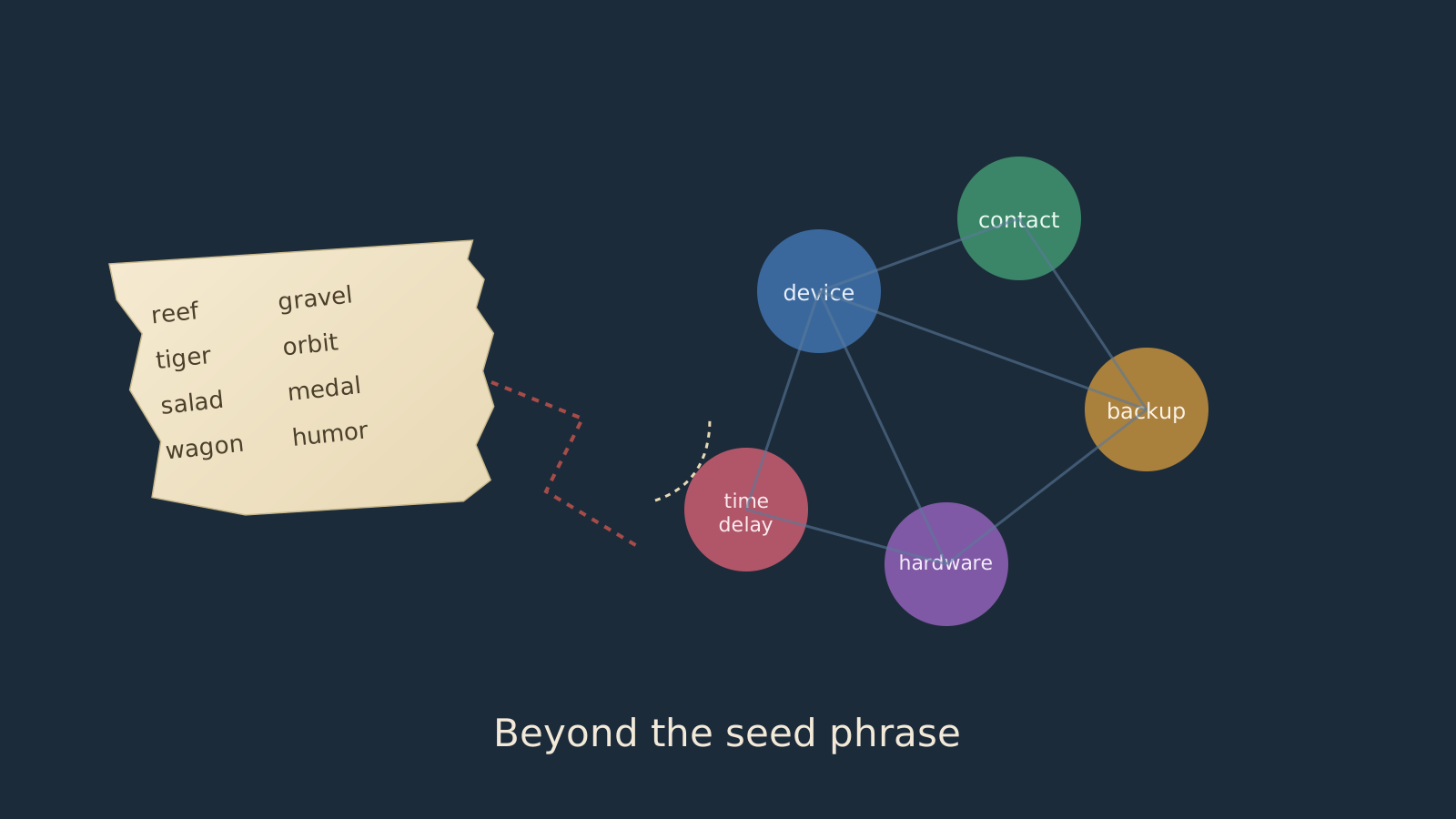
None of those pieces is sufficient on its own. Together, they make accidental loss dramatically less likely while keeping attackers from simply clicking a 'forgot password' button. The goal isn't to eliminate responsibility. It's to stop making a single piece of paper responsible for your entire financial future.
Recovery should be boring
This might be the most controversial thing we'll say: losing your wallet shouldn't become the defining story of your crypto journey. It should feel like replacing a lost debit card. A little annoying. A few verification steps. A cup of coffee while things synchronize. Then you're done.
Instead, we've normalized catastrophic failure. Entire Reddit threads are dedicated to people who lost life-changing amounts of money because of one typo, one house fire, one scam, or one moment of panic. That's not decentralization. That's fragile design.
The hardest part isn't cryptography
It's trust. People don't wake up wondering whether BIP-39 uses enough entropy. They wonder: 'If I lose my phone, am I going to lose everything?' 'If someone steals my device, can they empty my wallet?' 'If I make one mistake, is it over?' Those questions aren't solved by stronger encryption. They're solved by thoughtful product design.
That means explaining what's happening, showing clear confirmations, making risky actions difficult to perform accidentally, and being honest about trade-offs instead of hiding them behind technical jargon. That gap, between 'the system worked' and 'the person felt safe,' is the entire job of building a wallet.
The future of self-custody
There will always be power users who prefer maximum control. They'll keep offline backups, use hardware wallets, split secrets across multiple locations, and sleep better because of it. That's great. Those users should absolutely have that option. The mistake was assuming everyone else should use the exact same model.
The future of self-custody isn't fewer keys. It's fewer scary moments. People shouldn't need a YouTube tutorial before opening their wallet. They shouldn't have to decode warnings written for security researchers. They shouldn't have to choose between 'be your own bank' and 'hope nothing ever goes wrong.'
The best security products are almost invisible. They quietly prevent disasters before users even realize something could have gone wrong. That's the standard we're chasing. Not because seed phrases were a bad idea, they were one of the most elegant ideas crypto ever produced, but because great ideas don't have to be permanent ideas. If self-custody is ever going to reach billions of people instead of millions, we have to stop designing wallets that assume everyone is already an expert. We don't think the future of crypto is teaching everyone to think like cryptographers. We think it's finally building products that understand how humans actually behave.
Joseph Samuel
Co-founder @ Cosine Wallet - bringing the world closer to blockchain